There’s a mansion on the hill … (updated)

Developers paid better than the corn / But this was not the place where they were born — John Gorka, “Houses in the Fields” (Jacks Crows, 1991)

After the fall of 2011, each time I passed through the intersection of Ansley Street and Greenwood Avenue in Decatur’s Oakhurst neighborhood, Neil Young’s song title immediately popped into my head, along with the lyrics from two tunes on John Gorka’s 1991 album, Jack’s Crows. On the hill overlooking the intersection is Liz and Rob Broadfoot’s 2,800-square-foot home. Its historically inspired projecting bays and exaggerated Craftsman details look out over Oakhurst’s smaller homes conveying an air of conspicuous consumption and privilege.

Continue reading

The power of place: research roles and the Web

Folks in my trade, history and architectural history, find buildings and landscapes interesting. Yet, it is the people who designed, built, lived, and worked in them who are the real stars in architectural history. Sometimes I meet a building’s earlier occupants through the property’s current stewards; the former homeowner or resident knocking on the door of a current resident is an almost universal motif in architectural history narratives. Those connections yield invaluable information sources for people who study old houses.

Over the past decade a different kind of connection has been becoming more frequent. The Internet has democratized the past in ways not anticipated by traditional historians accustomed to archival and field research; reporting in academic journals and conference papers; and, to dialogues with colleagues and students. In 2011 I wrote a blog post on the history of Parkwood, a suburban Atlanta, Georgia, subdivision.  Parkwood was among one of the last subdivisions developed in Druid Hills, the large suburb historically linked with some of Atlanta’s leading Gilded Age entrepreneurs and noted landscape architect Frederick Law Olmsted and his successors. Continue reading

Revitalizing Washington neighborhoods

In 2007 and 2008, I did more than 60 oral history interviews and documentary research for Washington’s Local Initiatives Support Corporation (LISC) office. This week, LISC celebrated its 30th anniversary in Washington and it released a book derived from the interviews, written by community development expert Tony Proscio. Continue reading

The Oakhurst food desert (updated)

Oakhurst does not fit any colloquial or technical definition of “food desert” — “L.T.”, August 4, 2012

L.T.  is a 30-something software professional who describes himself as an “amateur economist” in his Twitter profile. He wrote several comments on this blog reacting to a June 2012 post on Oakhurst’s food desert. He strongly objected to my description of his neighborhood as a “food desert.”[1]

After several comments on the blog and private emails, L.T. admitted, “I had never heard of a food desert before you posted about it. I’m just a guy who can read and do math.”[2] This post responds to L.T.’s assertion that Oakhurst’s hip bars and eateries and an overpriced boutique market preclude his neighborhood from being described as a “food desert.”

Continue reading

Liquid gold in the forest

The buying of timber land for the purpose of securing the bark is naturally incident to the tanning business The company owns a large amount of land acquired in this way and owns and operates some sawmills for utilizing the timber on it — Lewis H. Lapham, 1901.[1]

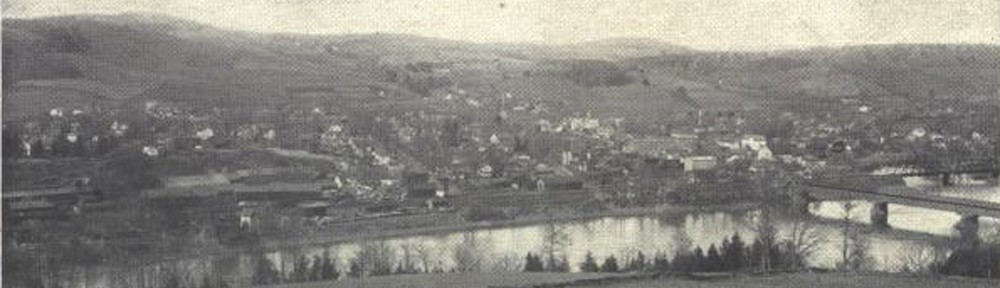
Western Pennsylvania is well known as the birthplace of America’s petroleum industry. Edwin Drake’s construction in 1859 of the nation’s first large-scale oil well laid the foundation for the industry that spread from Pennsylvania’s forests to the desert southwest within four decades.

Leroy Well. Stereograph, c. 1860-1870. Credit: Library of Congress Prints and Photographs Division Washington, D.C.

Continue reading

Bike bummer

[Link to updates]

Decatur police officer R. Lindsey completes the citation he issued me for running the stop sign on Oakview Road.

Last year I got my first moving violation citation in more than 20 years. Decatur, Georgia’s, only traffic cop, Robert Lindsey, ticketed me for running a stop sign on my bicycle. I paid the $212.50 fine plus $21.00 online payment fees and thought the experience was over. (Yes, if you add it up, I paid $233.50 for running a stop sign on a bicycle.)

When I logged into the Georgia Department of Driver Services Website to change the address on my driver’s license I was shocked to see that I had three points on my record. And where did those points originate? The September 2011 bicycle ticket.

Continue reading

Decatur Beacon Community update

The Decatur City Commission unanimously voted July 2, 2012, to allocate $1.3 million for consultants Rutledge Alcock Architects to prepare construction documents for redevelopment of the former Beacon and Trinity schools. The proposed project ultimately will cost $25 million.

Decatur Deputy City Manager Hugh Saxon’s June 28, 2012 staff report on allocating funds for the Beacon redevelopment project.

Continue reading

When the pub shed is a food desert (updated)

Decatur, Georgia, recently got lots of attention when placemaking PR man Scott Doyon blogged about his neighborhood’s pub sheds in “Pub Shed: Mapping your five minute stumbling distance.” Doyon’s post went viral among new urbanists.

The Decatur, Georgia, pub shed.” Adapted from Placeshaker’s larger map at http://placeshakers.wordpress.com/2012/05/03/pub-shed-measure-of-the-five-minute-stumble/

Missing from Doyon’s post, however, is that some of his Decatur “pub sheds,” notably the ones in Doyon’s own Oakhurst neighborhood, happen to be co-terminous with food deserts.

Continue reading

Decatur to adversely affect historic African American school (updated)

[Ed. note: Read the latest update documenting this property’s demolition, Separate and unequal: Preserving Jim Crow (July 2013)]

The City of Decatur, Georgia, is on a fast-track to redevelop a historic African American school site. Plans include demolition of parts of the former Beacon Elementary School and Trinity High School to make way for new public facilities.

An isolated historical marker outside the former African American school describes Decatur’s Beacon Community. Photo by author, February 2012.

Continue reading

Privilege, gentrification, and displacement in Decatur, Georgia

In the spring of 1979 the South Decatur Community Council, a volunteer group credited with helping revitalize the area now known as Decatur, Georgia’s Oakhurst neighborhood, raised serious concerns about gentrification and displacement. “Gentrification, Speculation, Displacement, Investment Potential. These will soon become common terms as more and more home buyers discover South Decatur,” wrote the organization in its April 1979 newsletter.

As gentrification has taken hold in Oakhurst over the past decade or so, the SDCC’s concerns have materialized in ways the organization could not have conceived. Not only has Oakhurst become whiter and more affluent than it was in the 1970s, it also has become less tolerant of people once welcomed by the community. More than 30 years ago South Decatur’s community leaders called on their elected and appointed officials to maintain housing, ethnic, and economic diversity in the neighborhood. Instead, their entreaties fell on deaf and disinterested ears, according to many of those leaders who still live in Oakhurst and others who have moved away, propelled by the loss of diversity they foresaw. Continue reading