Picking up on this morning’s blog post on my first visit to the National Archives at College Park with my new IPad, I am now sitting in the textual research room writing this post on the IPad. Continue reading
An IPad walks into the National Archives and meets wi-fi.
On Monday, November 29, 2010, I set out for the National Archives at College Park (Archives II) armed with my new IPad. This was my first research outing with the IPad. I was at Archives II on a project to identify Civilian Conservation Corps records related to a 1937-1940 lake improvement project in Wisconsin.
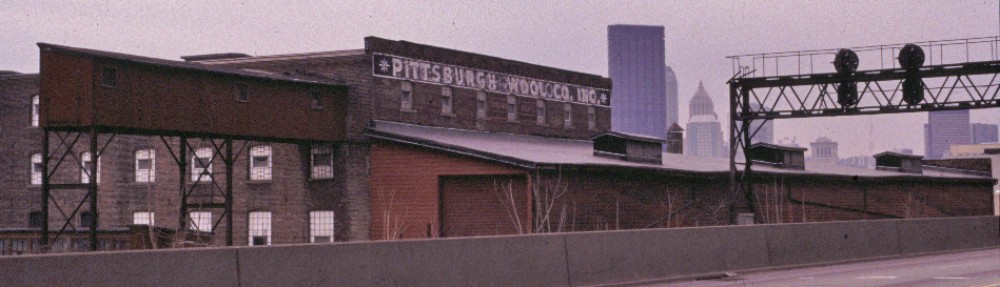
Pittsburgh loses another historic site with the demolition of former meatpacking plant
Wednesday afternoon, the day before Thanksgiving, I got a call from Pittsburgh Tribune-Review reporter Bob Bauder. Bauder was working on a story about the demolition of buildings located along the north shore of the Allegheny River in Pittsburgh. The reporter had gotten my name from a colleague who had kept a copy of a 1997 web page I had written about some historic preservation regulatory review work done along the road where the buildings known as the Millvale Industrial Park were located. Bauder wanted to get some more information on the building he had driven by many times and his story ran in the November 26, 2010, edition of the Pittsburgh Tribune-Review. Continue reading
The gas man, George Washington, and a magic lantern (Part I)
One hundred and sixty-three years ago this Thursday, gas lights replaced oil lamps in the U.S. Capitol. On the evening of Thursday, November 18, 1847, gas made in a plant beneath the Capitol flowed through newly installed pipes and into light fixtures throughout the building. “We witnessed last evening one of the most splendid and beautiful spectacles we ever beheld,” reported one Washington newspaper the next day. “It was the first time that the gas-lights of Mr. James Crutchett were exhibited.”
James Crutchett (1816-1889) was a self-styled engineer who briefly gained fame in 1847 for installing a gas-fueled lantern atop the Capitol dome in a failed bid to secure a contract to light the nation’s capital city. Crutchett spent the final 45 years of his life in Washington and his entrepreneurial exploits have largely been overlooked by Washington historians. His Capitol lantern scheme became a sidebar to architectural histories of the Capitol and his four decades as a gas man are little more than a footnote in the narratives on the history of Washington’s gas infrastructure. Continue reading
My research mistakes: a CRM parable
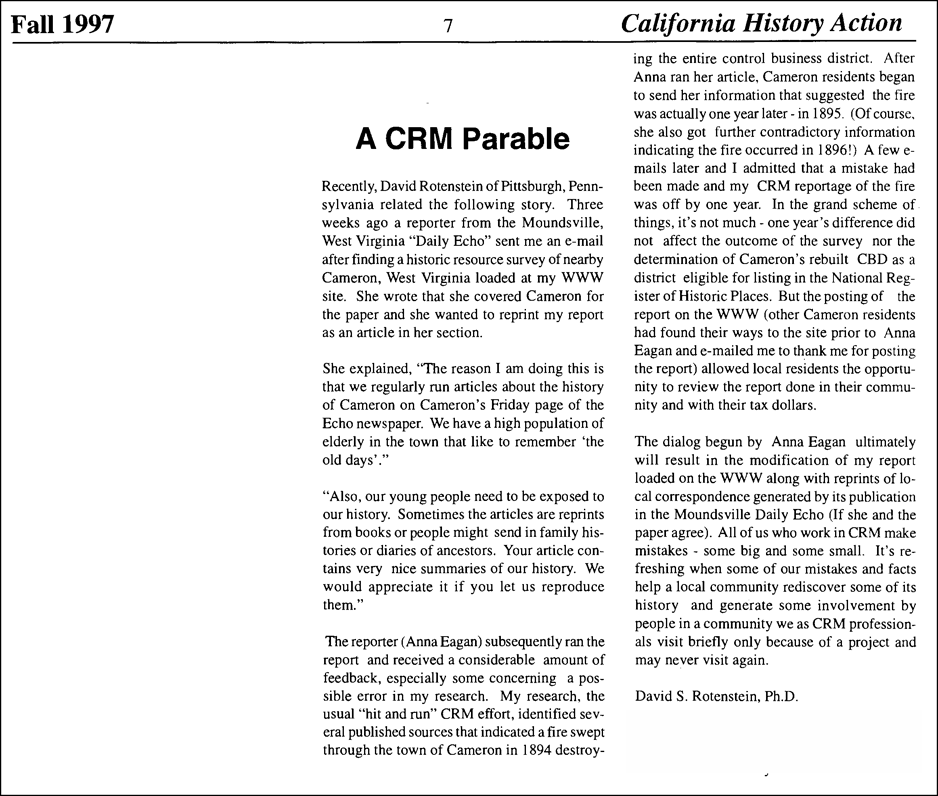
In 1997 the newsletter editor for the California Council for the Promotion of History read an email list post I had sent out documenting how the then-new Internet could contribute to revising historical research with factual errors. In that case, it was my factual error stemming from a Section 106 (National Historic Preservation Act) survey for a highway project (Internet Archive link) I had done a few years before the post.
Here is the reprint from the Fall 1997 California History Action newsletter:
Montgomery County’s historic preservation law is broken and needs a tune-up
The landmark 1978 Supreme Court decision in Penn Central Transportation v. New York City is sacrosanct to historic preservationists. The case settled the question of the constitutionality of local historic preservation landmarking laws. Penn Central and a handful of other precedents are historic preservationists’ first line of defense when lawmakers attempt to rewrite historic preservation laws like Montgomery County’s 31-year-old ordinance, a law sorely in need of a legislative tune-up.
Last year, Montgomery County Councilmember Mike Knapp attempted to amend Chapter 24A of the Montgomery County Code, the county’s historic preservation law. The councilmember who decided to not seek re-election this year wanted to revise the law by removing a controversial criterion for historic designation and by including provisions for owner consent prior to any property being designated historic. Continue reading
William Degges, the man who built “Lincoln’s Cottage”
The late 1830s and early 1840s were a period during which the United States government embarked on a public building campaign on a scale unseen in the District of Columbia since its founding some five decades earlier. While much of the nation was mired in a depression sparked by the Panic of 1837, entrepreneurs doing business with the federal government in the capital city appeared to flourish. William H. Degges (1812-1883) was a second-generation Washington builder and he was well positioned to profit from the boom. Continue reading
Building MoCo eruvim: Architecture and material culture (updated)
This is the second post in the series, Courtyards of Convenience: Montgomery County’s Eruvim
Introduction
The Capital Beltway carries I-495 through Washington, D.C.’s Maryland and Virginia suburbs. The iconic 64-mile highway completed in 1964 is a symbolic barrier between Washington and the rest of the nation. The dichotomy, inside versus outside the Beltway, has permeated popular culture.

National Capital Beltway showing portions adjacent to Montgomery County eruvim. Adapted from Bing Maps. Click on the image to see a full-size version.
A four-mile segment of the Beltway in Montgomery County, Maryland, acts as another symbolic boundary. Areas within this segment have been incorporated into the perimeters of two Orthodox Jewish eruvim that wrap around parts of Silver Spring and Wheaton creating symbolically enclosed spaces that allow Jews to move within them on the Sabbath. Continue reading
Goodbye Elmer
Elmer Blue died in July and we never knew.
We lived just a few houses away from Elmer in Silver Spring’s Northwood Park subdivision. We first met Elmer shortly after we moved into our house in late 2002. Elmer used to walk his aging pudgy terrier past our house and he would always stop by and talk to our basset hounds. My wife soon learned that Elmer liked our hounds because he once had a basset. Continue reading
MoCo eruvim just before Sabbath
This week I am documenting Montgomery County’s eruvim. While out shooting video and photos along the Capital Beltway I encountered one of the eruv inspectors who makes weekly checks to ensure that the eruv is intact for the week’s Sabbath. This video captures some of the chance encounter. Continue reading