Downtown Silver Spring may lose another locally owned and operated business. According to a November Silver Spring Singular blog post, the Peterson Companies are pressuring the Family Dry Cleaners to leave the prominent Wayne Avenue Shopping Center location they have occupied since 2000 when the center opened. The dry cleaner’s lease expires next March. The blogger wrote that Peterson — which manages Downtown Silver Spring under an agreement with Montgomery County — is courting CVS to occupy the space now held by the cleaners, along with adjacent spaces formerly occupied by Hollywood Video and MotoPhoto (later, an Upscale Pharmacy outlet).
Montgomery County Planning Board tosses Historic Preservation Commission votes, recommends new historic districts
The Montgomery County Planning Board last night voted to create two new historic districts in Clagettsville and Etchison in the county’s Upper Patuxent Planning Area. Last night’s meeting was the second work session held on proposed Master Plan for Historic Preservation designations since an October public hearing. Originally scheduled for early 2011, last night’s session was hastily added to the agenda because a property owner in one of the proposed historic districts pleaded with the Planning Board at its last work session on the designations to decide on her property before a purchase contract expires the end of the year. Continue reading
Silver Spring World’s Fair Home Art Deco Society newsletter article
The latest issue of the Art Deco Society of Washington‘s Trans-Lux newsletter is hot off the press (or whatever it is you call the PDF distiller). My article on Silver Spring’s 1939 World’s Fair Home:
[gview file=”http://www.historian4hire.net/pdf/Trans-Lux_Fall_2010x.pdf”]
© 2010 David S. Rotenstein
Snapshots of life inside Montgomery County’s eruvim
It’s been a fact of life in Washington for so long that people don’t notice — Rabbi Barry Freundel, Kesher Israel Synagogue, Washington, D.C.
Life inside an eruv, for Jews and non-Jews, is like life anywhere else. The boundary created by the eruv and the domain inside are meant to be unobtrusive and their builders strive for invisibility. I live inside an eruv and until I began than research, I was unaware of its existence or its limits. The same is true for many of my neighbors and friends and colleagues who live elsewhere in Montgomery County, Maryland. Continue reading
IPad and the National Archives: the second date
Picking up on this morning’s blog post on my first visit to the National Archives at College Park with my new IPad, I am now sitting in the textual research room writing this post on the IPad. Continue reading
An IPad walks into the National Archives and meets wi-fi.
On Monday, November 29, 2010, I set out for the National Archives at College Park (Archives II) armed with my new IPad. This was my first research outing with the IPad. I was at Archives II on a project to identify Civilian Conservation Corps records related to a 1937-1940 lake improvement project in Wisconsin.
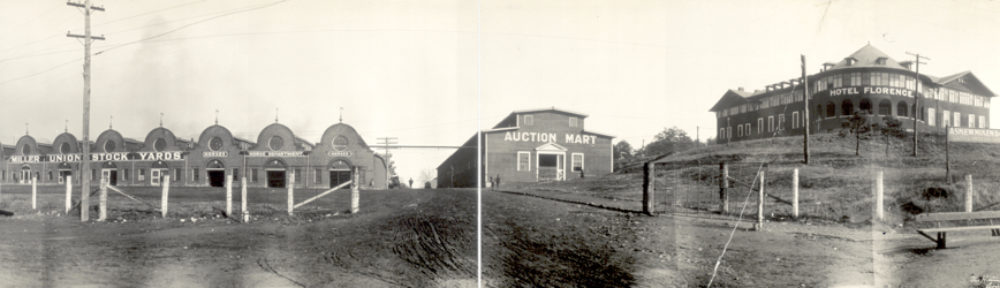
Pittsburgh loses another historic site with the demolition of former meatpacking plant
Wednesday afternoon, the day before Thanksgiving, I got a call from Pittsburgh Tribune-Review reporter Bob Bauder. Bauder was working on a story about the demolition of buildings located along the north shore of the Allegheny River in Pittsburgh. The reporter had gotten my name from a colleague who had kept a copy of a 1997 web page I had written about some historic preservation regulatory review work done along the road where the buildings known as the Millvale Industrial Park were located. Bauder wanted to get some more information on the building he had driven by many times and his story ran in the November 26, 2010, edition of the Pittsburgh Tribune-Review. Continue reading
The gas man, George Washington, and a magic lantern (Part I)
One hundred and sixty-three years ago this Thursday, gas lights replaced oil lamps in the U.S. Capitol. On the evening of Thursday, November 18, 1847, gas made in a plant beneath the Capitol flowed through newly installed pipes and into light fixtures throughout the building. “We witnessed last evening one of the most splendid and beautiful spectacles we ever beheld,” reported one Washington newspaper the next day. “It was the first time that the gas-lights of Mr. James Crutchett were exhibited.”
James Crutchett (1816-1889) was a self-styled engineer who briefly gained fame in 1847 for installing a gas-fueled lantern atop the Capitol dome in a failed bid to secure a contract to light the nation’s capital city. Crutchett spent the final 45 years of his life in Washington and his entrepreneurial exploits have largely been overlooked by Washington historians. His Capitol lantern scheme became a sidebar to architectural histories of the Capitol and his four decades as a gas man are little more than a footnote in the narratives on the history of Washington’s gas infrastructure. Continue reading
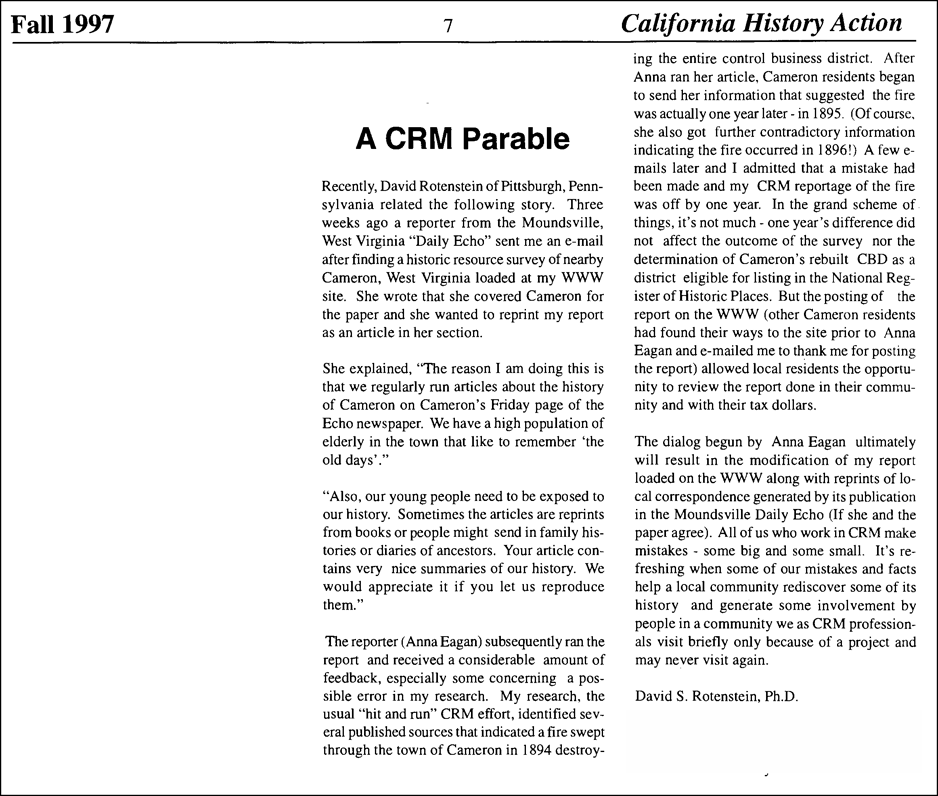
My research mistakes: a CRM parable
In 1997 the newsletter editor for the California Council for the Promotion of History read an email list post I had sent out documenting how the then-new Internet could contribute to revising historical research with factual errors. In that case, it was my factual error stemming from a Section 106 (National Historic Preservation Act) survey for a highway project (Internet Archive link) I had done a few years before the post.
Here is the reprint from the Fall 1997 California History Action newsletter:
Montgomery County’s historic preservation law is broken and needs a tune-up
The landmark 1978 Supreme Court decision in Penn Central Transportation v. New York City is sacrosanct to historic preservationists. The case settled the question of the constitutionality of local historic preservation landmarking laws. Penn Central and a handful of other precedents are historic preservationists’ first line of defense when lawmakers attempt to rewrite historic preservation laws like Montgomery County’s 31-year-old ordinance, a law sorely in need of a legislative tune-up.
Last year, Montgomery County Councilmember Mike Knapp attempted to amend Chapter 24A of the Montgomery County Code, the county’s historic preservation law. The councilmember who decided to not seek re-election this year wanted to revise the law by removing a controversial criterion for historic designation and by including provisions for owner consent prior to any property being designated historic. Continue reading