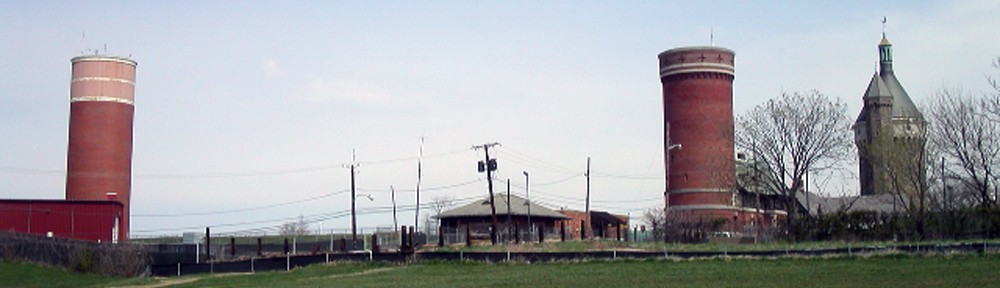
The R.M.S. Carmania: 1905 Maiden Voyage

I grew up in Daytona Beach, Florida. One of the childhood pastimes that I developed — and which led to a career in history and archaeology — was exploring abandoned buildings. Whether you call it “urban exploration” or “creeping” today, back in the 1970s I called it fun. My favorite spots were old houses awaiting teardown (in Daytona that meant 1930s vintage) and an old Atlantic Bank building. The bank building was the most fun: entry was gained through a broken drive-through window and from there you get to all of the other drive-through windows and the main bank building. Lying around were blank bank documents, some business records, and lots of trash left by vagrants and fellow trespassers who took up residence in this building located just three blocks from the beach. Continue reading

Silver Spring Drum Circle: Starting the Groove

August 28, 2010

Since July 2010, when the Silver Spring Civic Building and Veterans Plaza opened, a drum circle has gathered Saturday evenings. I wanted to see how the drum circle forms each week so I arrived at 6:30 PM to see how it comes together. Performances are complex social events. The activities leading up to the actual event can be as significant as the music or drama performed during the performance. With that in mind I tried to catch how the Silver Spring drum circle comes together as a performance. This video is compiled from clips I shot while watching the drummers and their audience gather between 7:00 and 8:20 PM in Veterans Plaza.

Continue reading

Unmaking Uncle Tom’s Cabin (Updated)

In 2006 Montgomery County, Maryland, received international attention for purchasing a 19th century farmhouse that oral tradition suggested was the original “Uncle Tom’s Cabin.” The county paid $1 million for a little over an acre in suburban North Bethesda. Now, four years later the county is holding community stakeholder meetings to map out the future of what officials are now calling The Josiah Henson Site. I recall the excitement surrounding the announcement that the legendary material link to American literary and social history would be “saved” from land hungry developers gobbling up Montgomery County real estate. Continue reading

Summer 2010 Update

The H4H Summer Update

Pittsburgh: Steel City, Stockyard City (updated)

My paper on the development of stockyards in the eastern United States (and ultimately, Chicago) was presented at the 2009 Vernacular Architecture Forum conference in Butte, Montana. Last week I learned that a revised and expanded version will be published later this year. Details to come. The paper was published in Western Pennsylvania History: Model for the Nation: Sale, Slaughter and Processing at the East Liberty Stockyards (2010).

In the meantime, here’s an illustrated version of the 2009 VAF paper abstract:

Continue reading

Architectural Adaptations: Silver Spring’s 1939 World’s Fair Home [Updated]

Update: See this later post on the home’s inclusion in a National Building Museum exhibit.

I am slowly getting around to revising my 2010 Vernacular Architecture Forum paper on Silver Spring’s 1939 World’s Fair Home. One of the areas that I was unable to deal with in the VAF paper was how the Silver Spring house differed from the one built in the World’s Fair Town of Tomorrow. This brief post is drawn from my ongoing work.

Continue reading

Frankenpines, Monopalms, and the Jolly Green Giant

I have been interested in concealed telecommunications sites since I first began working on regulatory compliance for Federal Communications Commission (FCC) licensees struggling to understand the complexities of Section 106 of the National Historic Preservation Act. This is the first of a series of posts on concealed telecommunications infrastructure and the American landscape.

Monopines. Whitemarsh Township, Pennsylvania.

Continue reading

Philly Folk Festival Season

Each summer Google directs dozens of visitors looking for information on the history of the annual Philadelphia Folk Festival. This year’s festival runs from August 20 through the 21st and the hits to my site are already picking up. Why is Google sending folks to my Web site? Because in the 1990s I covered folk music for the Philadelphia Inquirer and in advance of the 1992 festival I wrote a Sunday feature on the festival’s history and the folks behind it: The Philadelphia Folksong Society. I was finishing up my coursework at Penn at the time and I just happened to be enrolled in the now-defunct doctoral program in Folklore and Folklife. I also happened to be gearing up for the required FOLK 606: History of Folklore Studies class taught by the inimitable Dan Ben-Amos and I decided to use some of the reporting I did for the Inquirer article for one of my class papers. Since my time at Penn coincided with my early years writing about music I got to use interviews with folks like BB King and others as source material for term papers. Now that was cool.

For the Folk Festival story (and subsequent paper) I interviewed legendary Philly radio personality Gene Shay and many of the festival’s founders. I also interviewed Irish musician (and fellow Penn folklorist) Mick Moloney as well as George Britton (who died recently). Britton was a fun interview. Near the end of our interview he sang the chorus of a tune he wrote about the festival. He called the song, “Barefoot, Bearded and Bedraggled”:

I’m barefoot, bearded and bedraggled
Stoned and drunk as I can be
I’m the counterculture and I’m all folked up
This here’s my cry of liberty. Continue reading

Civil Defense

What would you do if you were sitting at the dinner table and a loud buzzer went off to inform you that the federal government had detected inbound nuclear missiles? Back in the late 1950s and early 1960s the government market-tested and field tested the National Emergency Alarm Repeater device to provide just such a warning.

Continue reading

The Undisclosed Location Disclosed: Continuity of Government Sites as Recent Past Resources

By David S. Rotenstein

[08/22/2011: Update: Read the follow-up post on newly identified photos showing the construction of the Fort Reno “Cartwheel” facility in Washington, DC]

In 2004 the State of Maryland was both project proponent and regulatory reviewer in the Section 106 consultations tied to the construction of a proposed telecommunications tower at Lamb’s Knoll, a mountaintop ridge that straddles Washington and Frederick counties west of Frederick. A Federal Communications Commission licensee, the State was required to identify historic properties, evaluate their significance under the National Register Criteria for Evaluation, and determine whether the proposed project would adversely affect properties listed in or eligible for listing in the National Register of Historic Places. Properties likely affected at Lamb’s Knoll included the Appalachian Trail, a 1920s fire observation tower turned telecommunications tower, and a Cold War-era army facility.

Corkscrew Tower Site, Lamb’s Knoll, Maryland. Photograph by David S. Rotenstein, 2004.

Maryland’s agency for emergency telecommunications infrastructure retained a cultural resource management firm to conduct the Section 106 compliance studies. The firm’s initial 2003 report noted the presence of nearby nineteenth century farmsteads and surrounding Civil War battle sites, but there was no mention of the twentieth century resources.[1] The Maryland Historical Trust (the state historic preservation office) reviewed the 2003 report and concurred with its authors that no historic properties would be affected by construction of the proposed tower. Located less than 500 feet from the proposed tower site and rising approximately 100 feet above the mountaintop, the former Cold War facility was notably absent from all discussions turning on historic preservation and the proposed tower. Hidden in plain sight and visible from miles around, the Lamb’s Knoll facility is one of a handful of continuity of government sites built in Maryland, Pennsylvania, Virginia, West Virginia, and Washington, D.C., that were designed to house large numbers of federal officials in underground bunkers while the exposed concrete towers that housed sophisticated radio equipment kept communications open among the survivors, the military, and civilian populations.

This article stems from my involvement in that 2004 project. I was retained by a coalition of environmental groups including the Harpers Ferry Conservancy and the National Trust for Historic Preservation to evaluate the historic properties the groups believed that the State’s consultant failed to identify in the initial round of Section 106 consultation. Between 2001 and 2008 I did many Section 106 projects for FCC licensees and I had been working on histories of postwar telecommunications networks.[2] By the time I had been brought into the Lamb’s Knoll project I was sensitive to the historical significance embodied in telecommunications facilities like the repurposed fire lookout tower and the Cold War facility.

Continue reading