The Walk

Thanks for your witness and devotion to justice — Rev. Nibs Stroupe, Oakhurst Presbyterian Church (Decatur, Ga.), Oct. 21, 2014.

After almost four years in Georgia, I am back in the Washington, D.C., area. Back home. The Georgia experience was one of incredible professional and personal growth. We lived and worked in a place where Old South racism mixes in a toxic civic cauldron with New South neoliberalism. Structural racism and privilege permeate all levels of Decatur, Georgia, society from city hall to city streets.

Decatur’s residents have shed their white hoods and replaced them with social media accounts and middle class respectability, PR firms, and false choice urbanism. For me, it was a rare opportunity to go from being an unwitting participant observer in a gentrifying neighborhood to an advocate for economic and racial equity.

The Decatur experience was transformative. I will use what I learned to be better: a better historian, better citizen, and better person. This week I began that journey on a walk with Rev. Jeffrey Thames, founder of Hope Restored, Inc., a Silver Spring, Maryland, nonprofit with a mission to work with the homeless and to open up the pipeline from incarceration back into the community.

© 2014 D.S. Rotenstein

Groundhog Day 2011

Each year I used to celebrate Groundhog Day with calls to friends and relatives and with home-made cards. People would send me Groundhog Day-themed cartoons and I would add them to my collection. Then, in 1993 Bill Murray’s Groundhog Day movie was released and the holiday went commercial. You just can’t compete with popular culture and I abandoned the annual Groundhog Day celebration. Continue reading

What do Uncle Tom, the Jolly Green Giant, and skateboarding have in common?

They are among some of the search phrases used by people visiting the H4H blog this week. If you find any unifying threads, please let me know. Continue reading

My research mistakes: a CRM parable

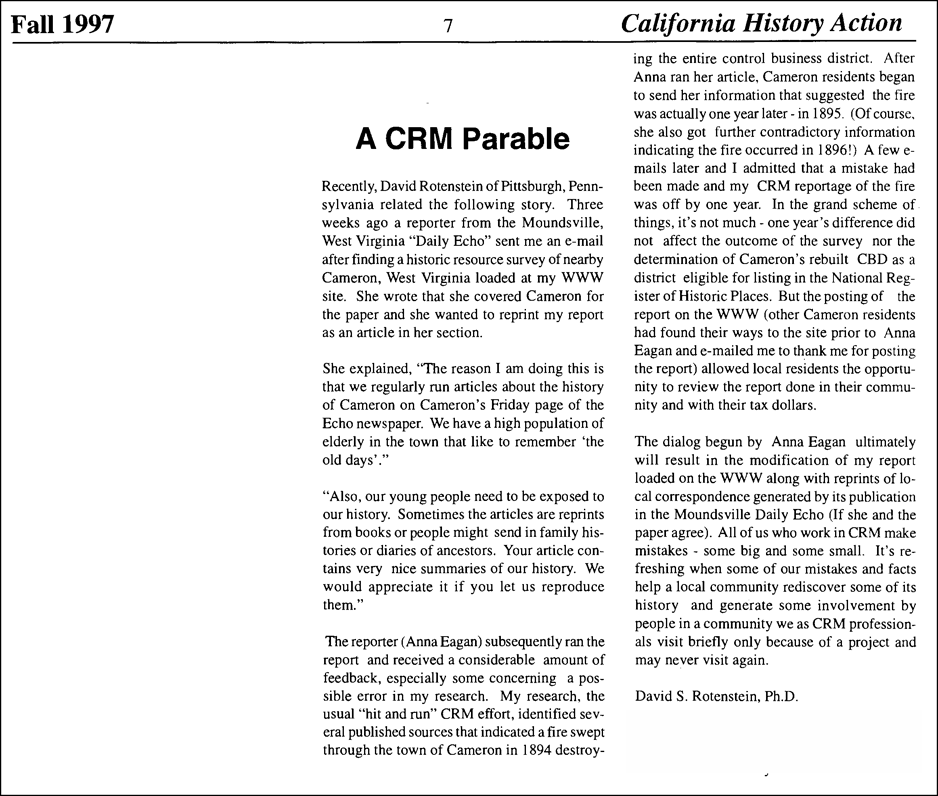
In 1997 the newsletter editor for the California Council for the Promotion of History read an email list post I had sent out documenting how the then-new Internet could contribute to revising historical research with factual errors. In that case, it was my factual error stemming from a Section 106 (National Historic Preservation Act) survey for a highway project (Internet Archive link) I had done a few years before the post.

Here is the reprint from the Fall 1997 California History Action newsletter:


Internet Autobiography: History & Prehistory

This morning I attended a blogging workshop at American University (#tbdau). Sponsored by TBD, the topic was finding your blogging voice and it gave me a chance to think about this blog and its antecedents. Continue reading

Going Historical, Going Folk: The Philadelphia Folk Festival Comes of Age

The copy of my article for the 2010 Philadelphia Folk Festival Program Book arrived via email. It’s a shame I couldn’t make it up to see the festival last month. The Philadelphia Folk Festival and the Philadelphia Folksong Society are historic institutions. Drawing on 25 years working in history and academic training in folklore, I can say without equivocation that the festival and its parent organization, the Folksong Society, are indeed historic. They easily pass the time test and both have had profound impacts on musicians, music lovers, folklorists, and communities throughout Southeastern Pennsylvania. Continue reading

The R.M.S. Carmania: 1905 Maiden Voyage

I grew up in Daytona Beach, Florida. One of the childhood pastimes that I developed — and which led to a career in history and archaeology — was exploring abandoned buildings. Whether you call it “urban exploration” or “creeping” today, back in the 1970s I called it fun. My favorite spots were old houses awaiting teardown (in Daytona that meant 1930s vintage) and an old Atlantic Bank building. The bank building was the most fun: entry was gained through a broken drive-through window and from there you get to all of the other drive-through windows and the main bank building. Lying around were blank bank documents, some business records, and lots of trash left by vagrants and fellow trespassers who took up residence in this building located just three blocks from the beach. Continue reading

Summer 2010 Update

The H4H Summer Update

Web History

Last week I distributed Historian for Hire’s  first e-update. In the one-pager I mentioned the first professional Web site I created. Designed for Cultural Resource Analysts, a cultural resource management company in Lexington, Kentucky, the site went live in January 1996. My local files for time I maintained the site have long since succumbed to data rot but the good folks over at the Internet Archive have it preserved on their servers. It’s not pretty nor is it flashy, but it did the job. And, if you surf through the company’s current Web site structure you will see that despite almost 15 years and multiple webmeisters, the basic architecture that I designed remains intact.

CRAI’s owner Chuck Niquette advertised the new site in a post to a young professional organization’s public listserv, ACRA-L. A few days later I registered the company’s new domain name and moved the site off of my grad school Internet account held at the University of Pennsylvania. The screen capture shows the front page in early 1996 and below is CRAI President Chuck Niquette’s announcement of its birth:

CRAI Home Page Announcement.

First Quarter 2010 Update

The first 2010 update went out last week. Check out what’s new.