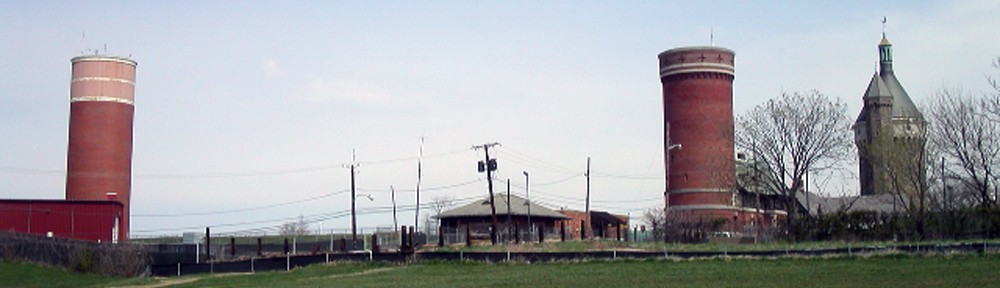
Daniel H. Burnham and Washington’s Union Stockyards

Earlier this month PBS aired Make No Little Plans: Daniel Burnham and the American City. As an architectural historian I have long admired Burnham’s work. Union Station and the Mall are incredible amenities for folks like myself living in the Washington area. My interest in Burnham, however,  goes beyond the architectural and city planning spheres. When he married Chicago Union Stockyards president John B. Sherman’s daughter Margaret, Burnham became part of the extended Allerton family, livestock entrepreneurs who profited from the shipment of most of the meat animals shipped into New York City during much of the nineteenth century.

Although Burnham never went into business with his father-in-law beyond his firm’s design of Sherman’s home and the Chicago Union Stockyards landmark gate, he did benefit from Sherman’s Chicago interests and he may have benefited from Sherman’s longtime relationship with the Pennsylvania Railroad. John B. Sherman (1825-1902) and Samuel W. Allerton Jr. (1828-1914) were cousins whose families had been in business together since the first decade of the nineteenth century. Continue reading

Going Historical, Going Folk: The Philadelphia Folk Festival Comes of Age

The copy of my article for the 2010 Philadelphia Folk Festival Program Book arrived via email. It’s a shame I couldn’t make it up to see the festival last month. The Philadelphia Folk Festival and the Philadelphia Folksong Society are historic institutions. Drawing on 25 years working in history and academic training in folklore, I can say without equivocation that the festival and its parent organization, the Folksong Society, are indeed historic. They easily pass the time test and both have had profound impacts on musicians, music lovers, folklorists, and communities throughout Southeastern Pennsylvania. Continue reading

John Skirving: From Bricklayer to Men of Progress

Sometimes it takes a real kick in the pants to get moving on turning a conference paper into something more. Last week I received an email from a history professor in the UK who is working on a project that parallels some research I presented in draft form at the 2007 Washington Historical Studies Conference. I allowed the National Trust for Historic Preservation to summarize the paper and post a link to a PDF of the entire paper at its President Lincoln’s Cottage Website. I have suggested a collaboration to my colleague across the pond rather than a race to get into print; we’ll see how that goes. In the meantime, I’d like to recapture a little bit of my own intellectual property by reprinting a slightly revised version of the 2007 paper with illustrations. Continue reading

The R.M.S. Carmania: 1905 Maiden Voyage

I grew up in Daytona Beach, Florida. One of the childhood pastimes that I developed — and which led to a career in history and archaeology — was exploring abandoned buildings. Whether you call it “urban exploration” or “creeping” today, back in the 1970s I called it fun. My favorite spots were old houses awaiting teardown (in Daytona that meant 1930s vintage) and an old Atlantic Bank building. The bank building was the most fun: entry was gained through a broken drive-through window and from there you get to all of the other drive-through windows and the main bank building. Lying around were blank bank documents, some business records, and lots of trash left by vagrants and fellow trespassers who took up residence in this building located just three blocks from the beach. Continue reading

Silver Spring Drum Circle: Starting the Groove

August 28, 2010

Since July 2010, when the Silver Spring Civic Building and Veterans Plaza opened, a drum circle has gathered Saturday evenings. I wanted to see how the drum circle forms each week so I arrived at 6:30 PM to see how it comes together. Performances are complex social events. The activities leading up to the actual event can be as significant as the music or drama performed during the performance. With that in mind I tried to catch how the Silver Spring drum circle comes together as a performance. This video is compiled from clips I shot while watching the drummers and their audience gather between 7:00 and 8:20 PM in Veterans Plaza.

Continue reading

Unmaking Uncle Tom’s Cabin (Updated)

In 2006 Montgomery County, Maryland, received international attention for purchasing a 19th century farmhouse that oral tradition suggested was the original “Uncle Tom’s Cabin.” The county paid $1 million for a little over an acre in suburban North Bethesda. Now, four years later the county is holding community stakeholder meetings to map out the future of what officials are now calling The Josiah Henson Site. I recall the excitement surrounding the announcement that the legendary material link to American literary and social history would be “saved” from land hungry developers gobbling up Montgomery County real estate. Continue reading

Summer 2010 Update

The H4H Summer Update

Pittsburgh: Steel City, Stockyard City (updated)

My paper on the development of stockyards in the eastern United States (and ultimately, Chicago) was presented at the 2009 Vernacular Architecture Forum conference in Butte, Montana. Last week I learned that a revised and expanded version will be published later this year. Details to come. The paper was published in Western Pennsylvania History: Model for the Nation: Sale, Slaughter and Processing at the East Liberty Stockyards (2010).

In the meantime, here’s an illustrated version of the 2009 VAF paper abstract:

Continue reading

Architectural Adaptations: Silver Spring’s 1939 World’s Fair Home [Updated]

Update: See this later post on the home’s inclusion in a National Building Museum exhibit.

I am slowly getting around to revising my 2010 Vernacular Architecture Forum paper on Silver Spring’s 1939 World’s Fair Home. One of the areas that I was unable to deal with in the VAF paper was how the Silver Spring house differed from the one built in the World’s Fair Town of Tomorrow. This brief post is drawn from my ongoing work.

Continue reading

Frankenpines, Monopalms, and the Jolly Green Giant

I have been interested in concealed telecommunications sites since I first began working on regulatory compliance for Federal Communications Commission (FCC) licensees struggling to understand the complexities of Section 106 of the National Historic Preservation Act. This is the first of a series of posts on concealed telecommunications infrastructure and the American landscape.

Monopines. Whitemarsh Township, Pennsylvania.

Continue reading