Summer 2010 Update

The H4H Summer Update

Pittsburgh: Steel City, Stockyard City (updated)

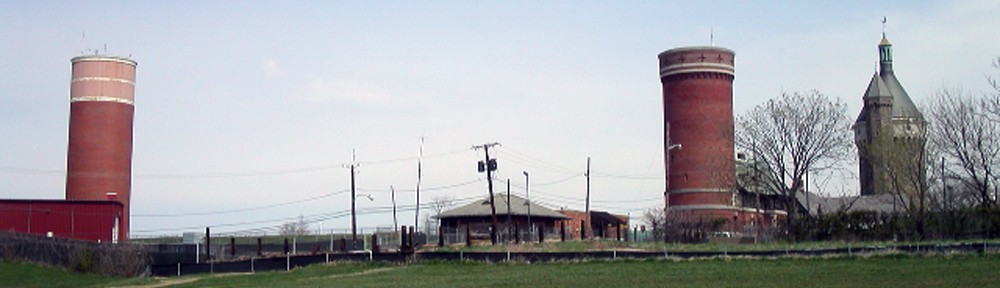
My paper on the development of stockyards in the eastern United States (and ultimately, Chicago) was presented at the 2009 Vernacular Architecture Forum conference in Butte, Montana. Last week I learned that a revised and expanded version will be published later this year. Details to come. The paper was published in Western Pennsylvania History: Model for the Nation: Sale, Slaughter and Processing at the East Liberty Stockyards (2010).

In the meantime, here’s an illustrated version of the 2009 VAF paper abstract:

Continue reading

Architectural Adaptations: Silver Spring’s 1939 World’s Fair Home [Updated]

Update: See this later post on the home’s inclusion in a National Building Museum exhibit.

I am slowly getting around to revising my 2010 Vernacular Architecture Forum paper on Silver Spring’s 1939 World’s Fair Home. One of the areas that I was unable to deal with in the VAF paper was how the Silver Spring house differed from the one built in the World’s Fair Town of Tomorrow. This brief post is drawn from my ongoing work.

Continue reading

Frankenpines, Monopalms, and the Jolly Green Giant

I have been interested in concealed telecommunications sites since I first began working on regulatory compliance for Federal Communications Commission (FCC) licensees struggling to understand the complexities of Section 106 of the National Historic Preservation Act. This is the first of a series of posts on concealed telecommunications infrastructure and the American landscape.

Monopines. Whitemarsh Township, Pennsylvania.

Continue reading

Philly Folk Festival Season

Each summer Google directs dozens of visitors looking for information on the history of the annual Philadelphia Folk Festival. This year’s festival runs from August 20 through the 21st and the hits to my site are already picking up. Why is Google sending folks to my Web site? Because in the 1990s I covered folk music for the Philadelphia Inquirer and in advance of the 1992 festival I wrote a Sunday feature on the festival’s history and the folks behind it: The Philadelphia Folksong Society. I was finishing up my coursework at Penn at the time and I just happened to be enrolled in the now-defunct doctoral program in Folklore and Folklife. I also happened to be gearing up for the required FOLK 606: History of Folklore Studies class taught by the inimitable Dan Ben-Amos and I decided to use some of the reporting I did for the Inquirer article for one of my class papers. Since my time at Penn coincided with my early years writing about music I got to use interviews with folks like BB King and others as source material for term papers. Now that was cool.

For the Folk Festival story (and subsequent paper) I interviewed legendary Philly radio personality Gene Shay and many of the festival’s founders. I also interviewed Irish musician (and fellow Penn folklorist) Mick Moloney as well as George Britton (who died recently). Britton was a fun interview. Near the end of our interview he sang the chorus of a tune he wrote about the festival. He called the song, “Barefoot, Bearded and Bedraggled”:

I’m barefoot, bearded and bedraggled
Stoned and drunk as I can be
I’m the counterculture and I’m all folked up
This here’s my cry of liberty. Continue reading

Civil Defense

What would you do if you were sitting at the dinner table and a loud buzzer went off to inform you that the federal government had detected inbound nuclear missiles? Back in the late 1950s and early 1960s the government market-tested and field tested the National Emergency Alarm Repeater device to provide just such a warning.

Continue reading

The Undisclosed Location Disclosed: Continuity of Government Sites as Recent Past Resources

By David S. Rotenstein

[08/22/2011: Update: Read the follow-up post on newly identified photos showing the construction of the Fort Reno “Cartwheel” facility in Washington, DC]

In 2004 the State of Maryland was both project proponent and regulatory reviewer in the Section 106 consultations tied to the construction of a proposed telecommunications tower at Lamb’s Knoll, a mountaintop ridge that straddles Washington and Frederick counties west of Frederick. A Federal Communications Commission licensee, the State was required to identify historic properties, evaluate their significance under the National Register Criteria for Evaluation, and determine whether the proposed project would adversely affect properties listed in or eligible for listing in the National Register of Historic Places. Properties likely affected at Lamb’s Knoll included the Appalachian Trail, a 1920s fire observation tower turned telecommunications tower, and a Cold War-era army facility.

Corkscrew Tower Site, Lamb’s Knoll, Maryland. Photograph by David S. Rotenstein, 2004.

Maryland’s agency for emergency telecommunications infrastructure retained a cultural resource management firm to conduct the Section 106 compliance studies. The firm’s initial 2003 report noted the presence of nearby nineteenth century farmsteads and surrounding Civil War battle sites, but there was no mention of the twentieth century resources.[1] The Maryland Historical Trust (the state historic preservation office) reviewed the 2003 report and concurred with its authors that no historic properties would be affected by construction of the proposed tower. Located less than 500 feet from the proposed tower site and rising approximately 100 feet above the mountaintop, the former Cold War facility was notably absent from all discussions turning on historic preservation and the proposed tower. Hidden in plain sight and visible from miles around, the Lamb’s Knoll facility is one of a handful of continuity of government sites built in Maryland, Pennsylvania, Virginia, West Virginia, and Washington, D.C., that were designed to house large numbers of federal officials in underground bunkers while the exposed concrete towers that housed sophisticated radio equipment kept communications open among the survivors, the military, and civilian populations.

This article stems from my involvement in that 2004 project. I was retained by a coalition of environmental groups including the Harpers Ferry Conservancy and the National Trust for Historic Preservation to evaluate the historic properties the groups believed that the State’s consultant failed to identify in the initial round of Section 106 consultation. Between 2001 and 2008 I did many Section 106 projects for FCC licensees and I had been working on histories of postwar telecommunications networks.[2] By the time I had been brought into the Lamb’s Knoll project I was sensitive to the historical significance embodied in telecommunications facilities like the repurposed fire lookout tower and the Cold War facility.

Continue reading

A Levitt Encounter

Architectural and cultural historians for decades have been tuned into the significance of the sprawling Postwar suburbs built by Levitt & Sons bearing the family firm’s name. Recent research into other Levitt developments like Belair in Bowie in the Washington, D.C., suburbs has expanded our understanding of the Levitts’ impact on modern cultural landscapes and in shaping American homeownership. Last week while doing some fieldwork in the Philadelphia suburbs I encountered a 1960s subdivision planned by firm president William J. Levitt (1907-1994).

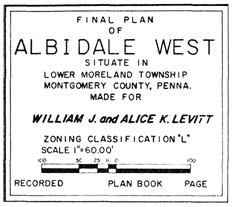
Named Albidale — Al (for Alice K. Levitt) and bi (for Bill Levitt) plus the rustic-sounding dale — the development included two tracts culled from a large 600-acre horse farm and steeplechase track assembled by Philadelphia philanthropist George W. Elkins (1886-1954) begun in the 1920s. Albidale’s core, dubbed Albidale West by Levitt, includes a cluster of stone homes Elkins built in 1936 for his employees and a pair of eighteenth century stone houses that once were part of farms Elkins bought in the 1920s and 1930s for his expansive Justa Farm complex.

Albidale West Plat. Montgomery County Land Records.

Earlier this year a new book on Pennsylvania’s Levittown, Second Suburb, was published and I have now moved my copy to the top of my reading list. The Levitts were fresh in my mind before I did last week’s fieldwork because I had just read Jamie Jacobs’ chapter on Belair in Richard Longstreth’s new book, Housing Washington. Jacobs’ 2005 dissertation has a valuable discussion of suburban real estate marketing techniques that I am using in my work on Silver Spring’s 1939 World’s Fair Home. Two things intrigue me about Levitt and they are beyond the scope of my current research project: 1) Levitt did not scrape away all evidence of the 18th, 19th, and early 20th centuries to make way for his development; and, 2) Levitt and his wife briefly lived in one of the Elkins houses. Continue reading

Video: Housing the Homeless in Washington

Earlier this spring I did a video for a client’s online annual report. The video — really a compilation of photos and interviews with a narration track — has been posted to the their YouTube channel. This was an exciting project because I got to use my ethnographer’s toolkit to tell a great story. The focus of the video is how organizations in Washington create supportive housing for the city’s homeless. Supportive housing programs provide chronically homeless people with a safe and affordable place to live along with access to services to help them get jobs, counseling, and other things necessary to re-integrate them into society. I met and photographed several formerly homeless women in one of Washington’s supportive housing apartment buildings and then I went to photograph homeless camps under Georgetown bridges. One woman who did not want to be photographed told me why the bridges were safer than homeless shelters and storefronts. Another woman proudly showed me around her apartment while explaining why she was reading Bill Gates’s book, Business @ the Speed of Thought. I would never have predicted ten years ago that I would be documenting Washington’s homeless people and the programs meant to help them.


Interchangeable Parts: 10 Years Later

Last week I attended the Vernacular Architecture Forum conference in Washington. Conferences are great events that give consultants (like yours truly) a chance to speak with colleagues from around the country. At the banquet I had a long conversation with someone who does cultural resource management work out in the Pacific time zone. We commiserated about the ranks of CRM firms who send out archaeological technicians to identify historic buildings and landscapes. We lamented the lack of regulatory oversight by federal agencies and state historic preservation offices to ensure that historical research and analysis were being done by historians and not archaeologists being kept billable by mega consulting firms.

Our exchange brought to mind similar conversations I had carried out with the late Ned Heite. Some of these took place on email lists like ACRA-L. One memorable one took place in June 2000. Ned aptly titled it “Interchangeable parts. Ned had responded to one of my posts, which read in part:

As I sit here looking through yet another Section 106 report on above-ground architectural resources prepared by archaeologists and rejected by a SHPO, I wonder when anyone in this industry is going to understand the “American System.” Interchangeable parts are things that are bulk or mass-produced that can be swapped out for in-kind identical parts in a tool, machine, whatever. If you’re going to apply the interchangeable parts model to the CRM industry, swap parts in offices, jobs, etc. with like parts. Don’t send archaeologists out to do what an architectural historian should do. After all, when your brakes go on your car, you’re not goign going to replace them with spark plugs, now are you?

Ned’s post read:

Bravo, David. As one who is “certified” by the SHPO in all the disciplines, I second your statement. By coincidence of employment, I have managed to push all the buttons for the Secretary’s standards. This does not, of course, mean that I know what I am doing.

Along those same lines, one of my pet peeves is the portable historian. When the weather turns bad, the state archives are flooded with field techs and others, who are supposed to be doing historical background research. Most of them haven’t the foggiest notion of historical research or the history of the locality.

Local history research is an arcane field, best left to people who are specialists in a very narrow geographical area. Yet CRM firms routinely dispatch unqualified staff to research the background history of places they can’t even pronounce!

The standards should be tightened, exponentially, and the historical background should be mandated to be done by a person with local expertise, who is also recognized as a competent CRM historian. And remember that a CRM historian is a very different creature from a kid with a fresh MA in some kind of generalized history.

Little has changed in the 10 years since that exchange. Large engineering companies with cultural resource management divisions continue to deploy teams of archaeologists to do historians’ work. I recall observing the archaeologists return from the field and in mixed horror and amusement watched them spend countless hours (and clients’ dollars) trying to match fuzzy photos of buildings with what they could find in Virginia and Lee MacAlester’s generic Field Guide to American Houses.

I still have the wonderful photo of a Prince William County privy that one archaeologist (who did not do the fieldwork, but who was given a stack of photos to describe) characterized in her report as a “desk.”

History in the crapper: one archaeologist’s “desk.”

Among some of the choice architectural descriptions penned by archaeologists are these: